
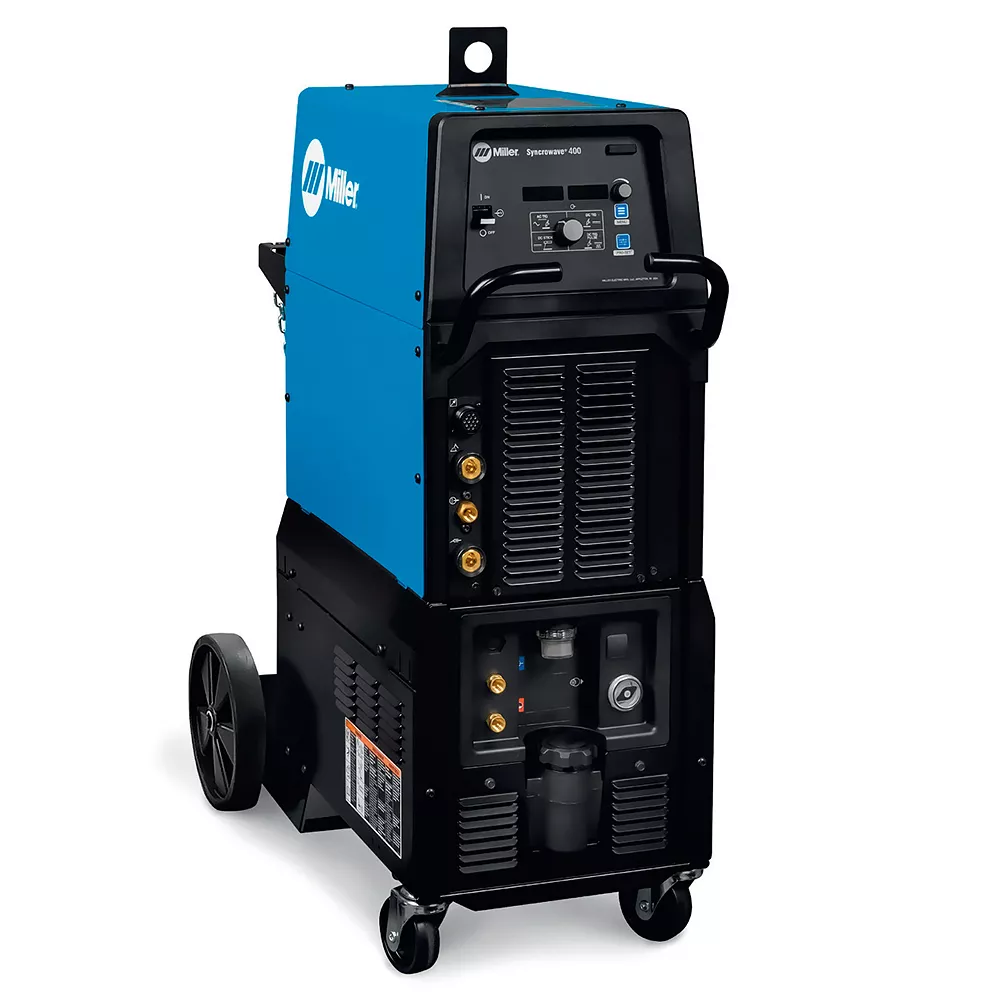
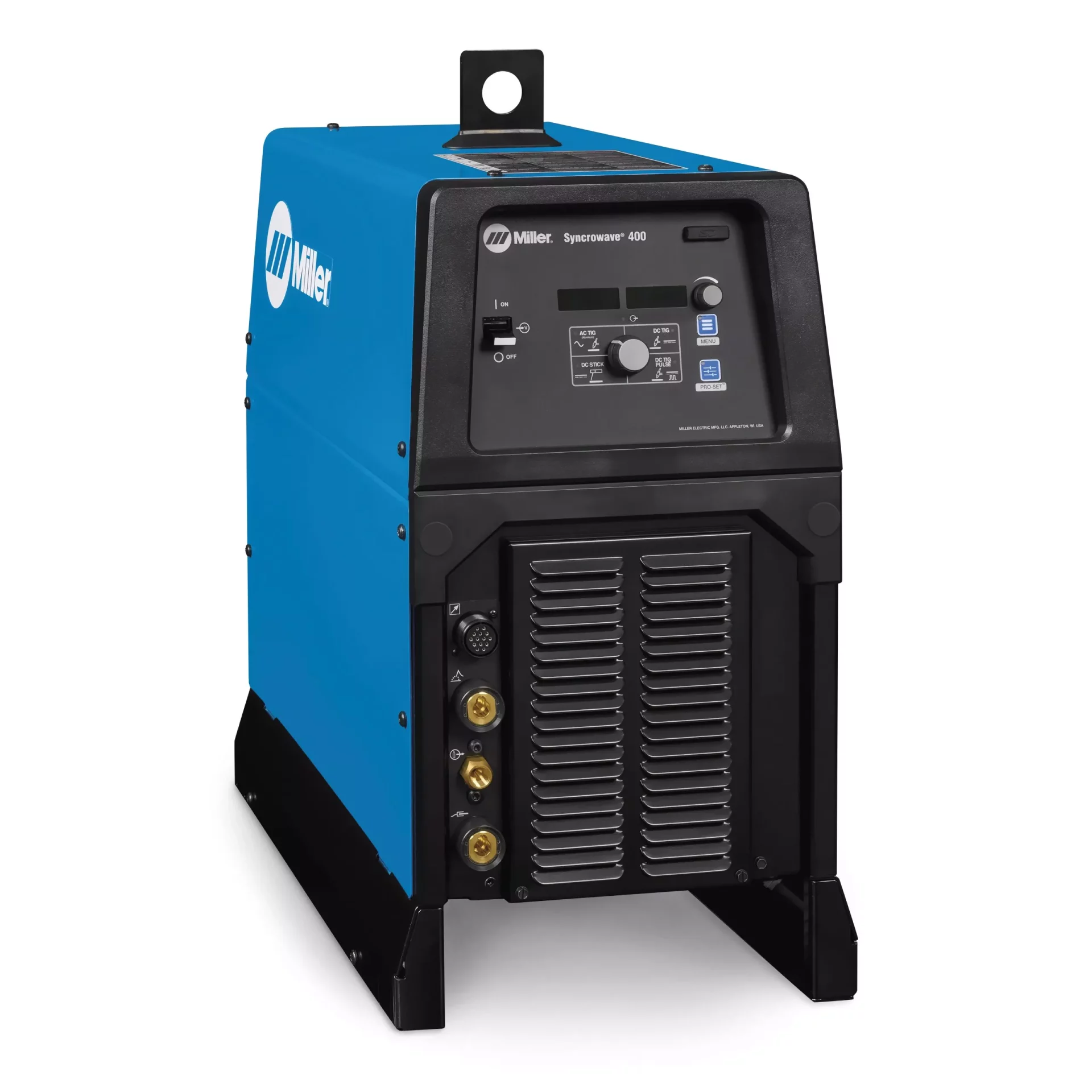
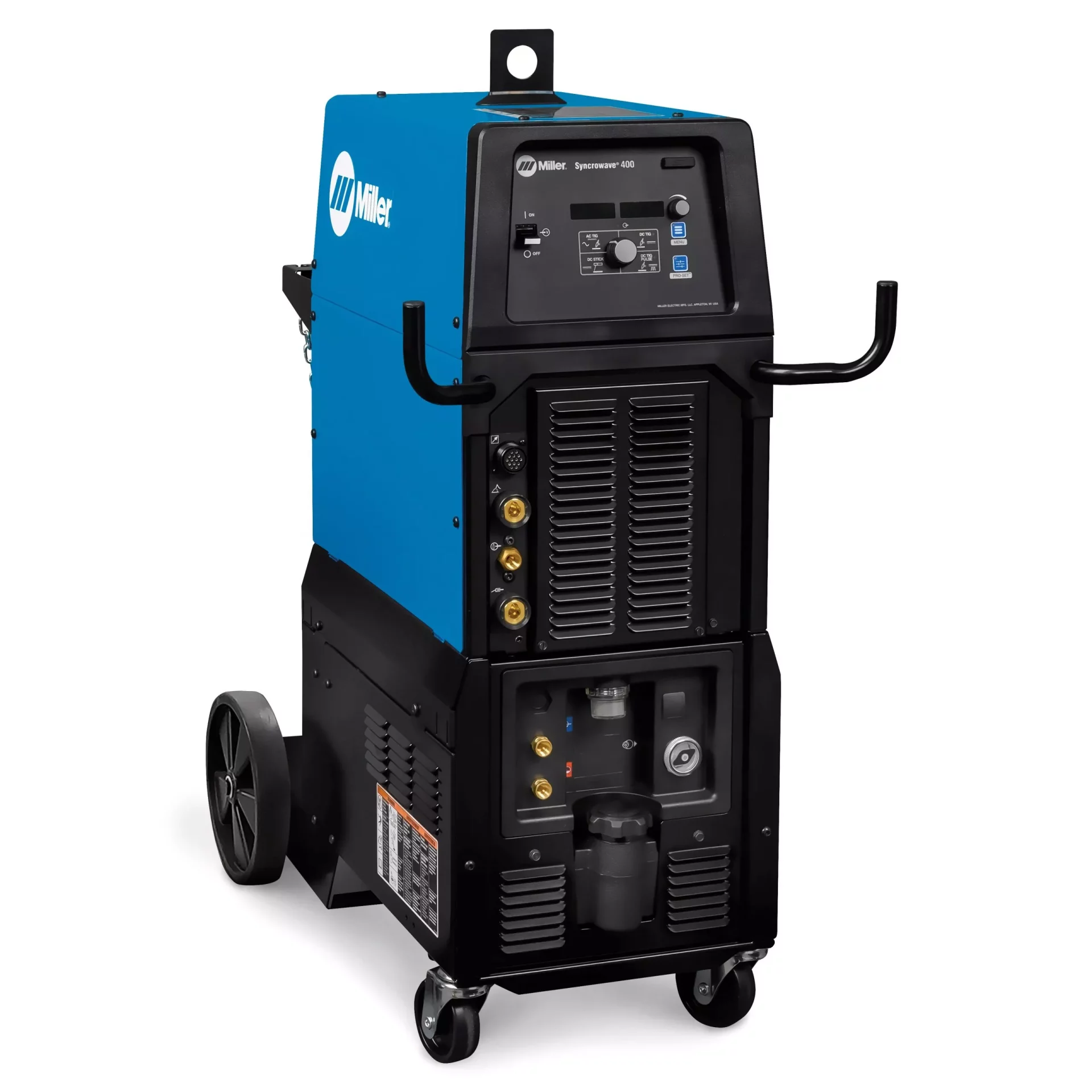
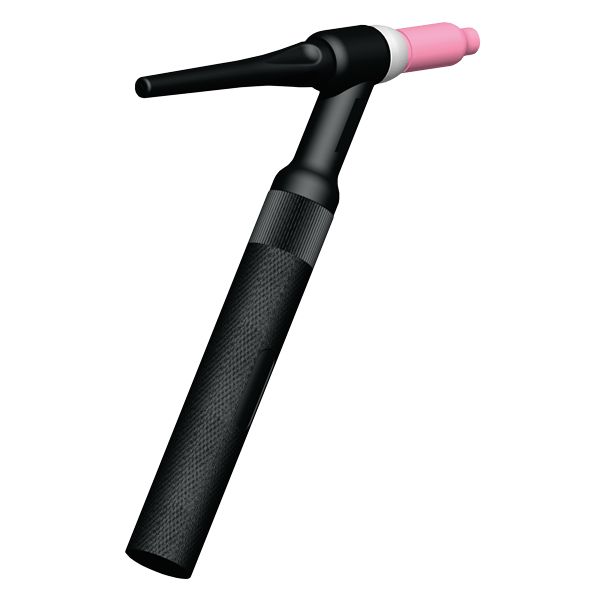


Miller Syncrowave 400 AC/DC Tig Welder – Water-cooled Tig Welding Package
Oxides that form on aluminum melt at temperatures over 2000°C (3.700°F) The aluminum material that is located under this layer of oxide melts at 649°C (1.200°F) The AC Squarewave welding current of the Syncrowave 400 automatically removes the layer of oxide which is necessary for producing high-quality welds.
Do you have power fluctuations?
The Miller Syncrowave 400 compensates for power fluctuation without changing your welding parameters. Line voltage compensation works on fluctuating power ±10 percent.
Easy-load cylinder rack
Minimizes cylinder lifting. Cylinder is not included.
Lift-Arc
Provides AC or DC arc initiation without the use of high frequency.
Blue Lightning high-frequency
(HF) arc starter for non-contact arc initiation. Provides more consistent arc starts and greater reliability compared to traditional HF arc starters.
Auto-post flow
Adjusts the length of post flow time based on the amperage setting, shielding your tungsten and eliminating the need to set the post flow time.
WARRANTY – 3 Years Miller’s True Blue Warranty Miller Syncrowave 400 AC/DC Water Cooled Tig Welding Package
An AC/DC TIG welder is a versatile welding machine that can operate with both Alternating Current (AC) and Direct Current (DC). This dual capability allows it to weld a wide variety of metals. AC is primarily used for welding aluminium and magnesium alloys, as it effectively cleans the oxide layer that forms on these metals. DC, on the other hand, is used for welding steel, stainless steel, copper, and other common metals, providing a more stable arc and smoother welds. TIG (Tungsten Inert Gas) welding, also known as GTAW (Gas Tungsten Arc Welding), uses a non-consumable tungsten electrode to produce the weld, making AC/DC TIG welders ideal for precision work where control and quality of the weld are paramount.
Can I weld aluminium with DC TIG?
Aluminium typically requires Alternating Current (AC) for TIG welding. This is because AC provides a cleaning action that removes the oxide layer on the surface of aluminium, which is essential for a high-quality weld. DC TIG welding can struggle with this oxide layer and might lead to inferior weld quality. For optimal results when welding aluminium, using AC TIG welding is advised due to its effectiveness in managing the unique properties of aluminium.





Reviews
There are no reviews yet.